


 Patients and Parents
 Visitors
 Healthcare Professionals
 Research
 Donate and Support
 About HKCH
Varicocele
Introduction
A varicocele is a common condition seen in 15% of adolescent boys where the veins within the scrotum (the loose bag of skin that holds the testicles) become enlarged, often described as feeling like a "bag of worms." While many men with a varicocele have no problems with fertility, it is a frequent finding in men who do have difficulty fathering children. This potential link to future fertility makes the management of varicoceles discovered during adolescence—when boys are not yet trying to have children—a topic of careful consideration and sometimes debate among doctors and families.
Causes
The exact cause is not always clear, but it is primarily due to faulty valves inside the veins that normally prevent blood from flowing backward. This malfunction allows blood to pool, increasing pressure and causing the veins to stretch and enlarge. Varicoceles are much more common on the left side (about 80% of cases) due to anatomical differences: the left testicular vein drains into the left kidney vein at a right angle, which can create more pressure. In rare cases, especially if a varicocele appears suddenly on the right side or in a very young boy, it can be a sign of an abdominal mass blocking blood flow, which requires further investigation.
Signs and Symptoms
Often, a varicocele causes no symptoms and is discovered during a routine physical exam. When symptoms do occur, they may include:
- A visible or palpable lump: The most common sign is a soft, irregular mass above the testicle, often noticeable when standing.
- Aching or dull discomfort: A feeling of heaviness, dragging, or aching in the scrotum, especially after prolonged standing or physical exertion.
- Testicles size difference: Over time, the affected testicle may grow more slowly or appear smaller than the other, which is a key factor doctors monitor.
Diagnosis
An ultrasound will be arranged to confirm the diagnosis and assess testicular volume on both sides. Semen analysis in prepubertal children is not routinely done in our hospital.
Treatment and Management
Conservative management: For many adolescents with a small, painless varicocele and no difference in testicles size, the recommended approach is simply regular monitoring with annual physical exams, and sometimes ultrasounds, to check for any changes.
Intervention is typically considered if:
- There is a significant size difference (usually >20% smaller) between the two testicles done on two separate ultrasounds, 6 months apart
- The adolescent experiences symptoms such as persistent pain or dragging sensation
- Abnormal semen analysis in older teens (semen analysis is not routinely done in our hospital)
The goal of treatment is to seal off the abnormal veins, redirecting blood flow to healthy pathways. Options include (all require general anaesthesia):
- Surgical ligation: This is the most common approach where surgeons tie off the enlarged veins, approaches include:
- Open surgery: A small incision is made in the abdomen or groin.
- Laparoscopic (minimally invasive) surgery: Uses small incisions and a camera, with sparing of the lymphatics utilising lymphatic highlighting agents (Fig. 1).
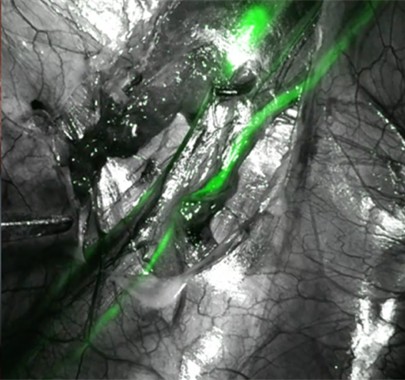
▲ Figure 1. Laparoscopic lymphatic sparing ligation of testicular vessels. Lymphatic channels highlighted in green by agent Indocyanide Green and spared to reduce postoperative hydrocele rate.
- Scrotal antegrade sclerotherapy: a small catheter is threaded into the vein, and sclerosing agent are used to block it.
Follow-up Care
Post-treatment follow-up is important to ensure success and monitor for complications. After surgery or embolization, patients are advised to avoid strenuous activity for at least a 4 weeks period. Follow-up visits will include:
- A physical exam to confirm the varicocele is no longer present.
- Monitoring of testicular growth with ultrasounds.
- Watching for potential but uncommon complications like hydrocele (fluid swelling), recurrence of the varicocele, or, very rarely, testicular shrinkage or damage.
The long-term outlook is generally excellent. Successful treatment typically resolves pain, allows for testicular catch-up growth, and improves semen parameters in most cases, thereby aiming to protect future fertility potential.
References
- Hung JWS, Yam FSD, Chung KLY et al., Comparison of scrotal antegrade sclerotherapy and laparoscopic Palomo surgery in treatment of adolescent varicocele: A 15-year review. J Pediatr Urol. 2018; 14:534.e1-534.e5.
- Chung KLY, Hung JWS, Yam FSD et al., Prospective randomized controlled trial comparing laparoacopic Palomo surgery vs scrotal antegrade sclerotherapy in adolescent varicocele. J Urol. 2023; 209: 600-610.
- Hung JWS, Yam FSD, Chung KLY et al. Long lasting effect on testes following methylene blue injection in laparoscopic lymphatic sparing varicocelectomy. J Pediatr Urol. 2023 Apr;19(2):217.e1-217.e6.
- Practice Committee of the American Society for Reproductive Medicine. Report on varicocele and infertility. Fertil Steril. 2006; 86: S93-5.
- Tekgul et al. EAU guidelines on Paediatric urology 2024: European Association of Urology and European Society of Paediatric Urology. Available from https://www.uroweb.org/guideline/paediatric-urology/ last
Acknowledgement
Principal author: Dr Judy Hung on behalf of Department of Paediatric Surgery, HKCH
Initial posting: Oct 2026
© 2026 Hong Kong Children’s Hospital. All rights reserved.